February 2024 Update
My last post ended with:
I hope to write a followup entry about this project in a few weeks!
Wow, I knew I was an optimist, but that was very optimistic! I am a reader, not a writer, that is for sure. Writing takes effort. One thing is feeling “I really enjoyed this book!”, but another is putting down in words a coherent sentence about why you liked it. But here we are, I’ll make an effort, do a brief update, and see how it goes!
Fiction Books
Last year I read my first books by Annalee Newitz. I had seen praise for her on my twitter feed, and when I went on Amazon, I was sold by quotes from Neal Stephenson1 and William Gibson2. The first one was Autonomous. I loved its futuristic, cyberpunk atmosphere and how she portrays a future of robots coexisting with humans, and the relationships amongst them, and with humans. The second one was The Terraformers, tens of thousands years in the future, where corporations create and own entire planets. Life is built. You are decanted, not born. Brains are grown. Bodies are built with redundant systems that repair the organism and people live hundreds and thousands of years. I like these kind of books that use science fiction to explore, essentially, what makes us humans, what is gender and themes like these. Reminded me a bit of Ursula K. Le Guin.
I read Babel, by R. F. Kuang. I had read The Poppy War series and found them to be page-turners. I was impressed by Babel. I really, really, really enjoyed it. The inter-crossing of magic working through silver by means of linguistics, being setup in the 1800s, the suspense, and the oppressed fighting their colonial overloads was just excellent.
I finished Octavia E. Butler’s Patternmaster series. Last year I read Clay’s Ark and Patternmaster. I love her writing! I can’t believe I only heard about her because they named the landing site of the Mars 2020 Perseverance rover after her. It is hard to describe the series. The first book, Wild Seed, presents this sort of spirit that collects and breeds special people. It has no body, and kills by taking a new body. He oversees all his projects over thousands of years. During Clay’s Ark, we get some aliens into the competition, after humanity’s first manned spaceship to another solar system returns home. Great series.
I also read A Wizard of Earthsea, by Ursula K. Le Guin. It is a first of a series of books for a more juvenile audience. I will certainly read the rest. She is probably my favorite science fiction writer.
And lastly, I read Doomsday Book by Connie Willis. Also a first book of a series. It portrays a time when time-travel is kind of normal. The history department in Oxford sends its researchers into the past to better study it, and one gets stuck in the middle ages. It reminded me a bit of Timeline, by Michael Crichton, though I read that decades ago. I like these type of books, so I’l probably finish this series too!
Other books
I am not sure why I make this distinction, but it is done. The ink is dry, I cannot erase it.
I read a Russian classic, The Master and Margarita. I first heard about this book because I listen to an Italian podcast: Il podcast di Alessandro Barbero: Lezioni e Conferenze di Storia. Quick segway. One day I was frustrated at how difficult it was to find a good italian podcast because I didn’t want to learn Italian. I wanted to listen to it (I live in Argentina, my iPhone is in English, and quite frankly, the search function in Podcast app sucked for this chore). Eventually I found this podcast, thinking it would bore me to death and was surprised about how interesting I found medieval politics in the city-states of Italy. Anyway, Alessandro Barbero had a conference where he talks about three Russian authors, and in one, he talks about this book, and how it probably is his favorite novel of all times. A few weeks later, someone I follow on twitter coincidentally said it was the best novel he had ever read. Maybe the universe was telling me something, so I tried to choose an edition with good commentary. I knew that small details like “the clothes the character is wearing were typical of a [insert relevant piece of information to the plot here]” would fly past me without it. It is as good as they say. Highly entertaining.
I read The Book of Why: The New Science of Cause and Effect. Excellent book! I was blown away by it, and by the fact that I had not heard about it before. I liked learning more about the history of statistics. It gets into quite some detail about the big public health issue that lingered in the public for many years (does smoking cause cancer?), and many more things. I majored in economics, and by third year I knew I didn’t like it, after reading this book I even understood why I didn’t like it better.
I enjoyed Good Math: A Geek’s Guide to the Beauty of Numbers, Logic, and Computation. It is a light read if you are into those kind of things. I like reading books about math at this not-so-in-depth level.
And lastly, this time for real, I read two books in Italian that took a disproportional amount of time because I have to lookup at least 6 words in each page. The first book was Problemi: Una guida per capire «l’assurdità» del presente by (Jonathan Zenti)[https://jonathanzenti.com/]. I heard about his podcast from Alessandro Barbero’s podcast and his style of storytelling immediately clicked with me. When he announced he had written a book, I said to myself, why not? I was finishing the My Brilliant Friend book series and boy was I ready for some light Italian reading. He did a summer podcast, Problemi DELI and at the end of each episode there was someone who recommended a book to read in you summer holidays. From there, I chose La vita sessuale di Guglielmo Sputacchiera by Alberto Ravasio. Like in Kafka’s Metamorphosis, the main character wakes up in another body. In this case, the young man wakes up in a womans body. It is not such a light reading as I expected, and the ending is kind of brutal. But I am glad I read it!
Rust and personal finances
I did continue working on my Rust program to perform my personal finance data-cleanup. I use it every month and it is orders of magnitude better than what I had before. It does save me time, as I added most of the functionality I wanted.
I like it so much that I sometimes think of not only using it as data-entry tool, but also to be able to import all my data into it. I won’t do it, at least not with this TUI crate I am currently using. I am using Cursive:
Cursive is a TUI library - it lets you easily build rich interfaces for use in a terminal.
And it does simplify a lot, compared to other lower-level ones. But it is callback-driven, and Rust and closures can sometimes be complicated for beginners like me. I’d need to read more programs written in it to understand how they model things like the stack in the UI (I click on a transaction, which renders a new widget, I click on that to further edit it, etc.). While looking at alternatives, I saw slint and found it very appealing. I also was intrigued into looking at what appflowy uses, given it is an open-source notion competitor written in Rust.
Functional Programming and Programming Languages
Besides my Italian podcasts, I like listening to things related to programming languages and for some reason, functional programming languages.
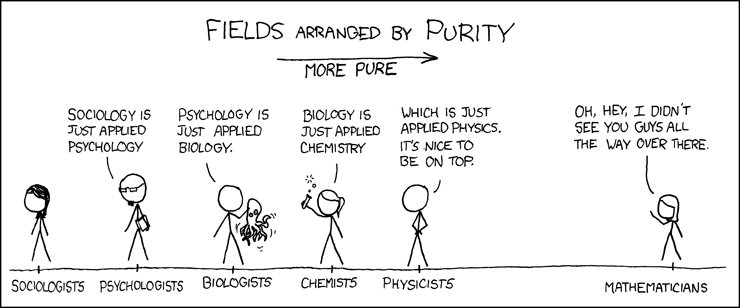
I really like The Haskell Interlude podcast. They have great guests and many many topics are way over my head, but I enjoy listening to the history of Haskell, how it evolved and evolves in academia and jumps to industry. In episode 26 for example, Simon Marlow talks about how they use it in Meta. I liked episode 36 where John Hughes talks about the origins of QuickCheck testing. And of course episode 38 with Edwin Brady, who created Idris - reading his book was challenging. I could go on. When I hear a british or scottish accent, I know I am in for a treat. Listening to this podcast reminds me of this comic, where Haskell are the mathematicians:
I enjoyed several of Pedro Abreu’s Type Theory Forall podcasts, not only because of all the way-over-my-head topics, but also because they give you a small glimpse of the world in academia, and the difference between US/UK. If you are interested in those, go listen to episodes 31 and 32.
Not programming languages per-se, but the crew at Oxide and Friends do hit some programming-languages related topics. There are so many good episodes, it is hard to choose which to list. If you use ChatGPT or Gemini or another LLMs, go listen to Open Source LLMs with Simon Willson. If you were following the Terraform saga, go listen to Fork in the road for Terraform? and Open Source Anti-Patterns with Kelsey Hightower.
It was on their Settling Beef episode where I heard about the ADSP: The Podcast. So in the Books in the box redux episode of June 2022, Adam Leventhal says that Beautiful C++ is essentially an advertisement for Rust. Conor listens to this, and plays it to his co-host Bryce and well, they invite him to the Settling Beef episode. If you like learning about other programming languages, you’ve got to listen to the ADSP podcast.
I could recommend several of the ADSP episodes, but for the purposes of this post, I’ll stick with episodes 156 to 159, where they interview Richard Feldman, the creator of The Roc programming language. Richard describes Roc as Elm for the backend. He enjoyed using Elm so much for the frontend, and he wished he could have the same rewarding experience when working in the backend, so he decided to create Roc. I then proceeded to read his Elm in Action book, and I’ll try to make a series of blog posts about my experience with using Elm. I had looked at Elm several years ago, but it hadn’t clicked with me. Maybe it is time to rewrite my small web-app to track cash expenses to try it out!
-
“Autonomous is to biotech and AI what Neuromancer was to the Internet.” —Neal Stephenson ↩︎
-
“Something genuinely and thrillingly new in the naturalistic, subjective, paradoxically humanistic but non-anthropomorphic depiction of bot-POV—and all in the service of vivid, solid storytelling. “—William Gibson ↩︎